

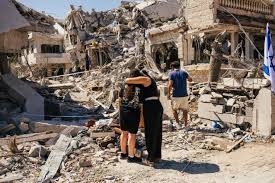
In the early hours of June 13, Israel launched what it called a “preemptive” strike against Iran, unleashing a wave of explosions across the country. The targets included nuclear facilities at Natanz and Fordo, military bases, research centers, and residences of senior military officials. By the end of the operation, Israeli forces had killed at least 974 people. In retaliation, Iranian missile strikes claimed the lives of 28 in Israel.
Thank you for reading this post, don't forget to subscribe!Israel framed the assault as an act of anticipatory self-defense, arguing that Iran was only weeks away from developing a functional nuclear weapon. However, intelligence assessments—including those from the United States, a close Israeli ally—and reports from the International Atomic Energy Agency (IAEA) found no evidence that Tehran was actively pursuing a nuclear weapon. At the time, Iranian diplomats were also engaged in negotiations with U.S. officials over a potential revival of the nuclear agreement.
MORE READ: ইরানে ‘অপারেশন মিডনাইট হ্যামার’ নামে মার্কিনি হামলা তৃতীয় বিশ্বযুদ্ধের আভাস

eyond the military tactics and geopolitical implications, a deeper ethical dilemma emerges: Can it ever be morally justifiable to launch a devastating attack not in response to an actual offense, but based on what a nation might do in the future? What precedent does this establish for the international community? And who has the authority to determine when perceived threats—or fear—are enough to warrant war?
Ethicists and international legal scholars draw a sharp distinction between preemptive and preventive war. Preemptive action responds to an immediate and imminent threat—an attack about to occur. Preventive war, by contrast, aims to neutralize a potential future threat that may or may not materialize.
MORE READ: Fires in Los Angeles are expected to intensify again and fire is 45% contained
Only preemptive war is considered morally legitimate under traditional just war theory, rooted in the writings of Augustine and Aquinas and reaffirmed by modern thinkers like Michael Walzer. This principle is encapsulated in the historic Caroline doctrine, which allows the use of force only when a threat is “instant, overwhelming, and leaving no choice of means, and no moment for deliberation.”
By this standard, Israel’s strike on Iran does not qualify. Iran was not on the brink of developing a nuclear weapon. Diplomatic channels had not been exhausted. The scale of destruction—particularly the risk of radioactive fallout from damaged centrifuge sites—vastly exceeded what could be justified as military necessity.

International law reflects these moral boundaries. Article 2(4) of the UN Charter prohibits the use of force, allowing only one exception: Article 51, which permits self-defense only after an armed attack occurs. Israel’s claim of anticipatory self-defense is based on disputed interpretations of customary international law rather than clearly established treaty obligations. UN experts have denounced the strike as “a blatant act of aggression” that violates jus cogens—the most fundamental norms of international law.
MORE READ: What motivates people to make New Year’s resolutions?
Making exceptions to these rules comes at a steep price. If one state can invoke speculative threats to justify military action, others will follow. China could cite patrols near Taiwan; Pakistan could react to perceived Indian military posturing. The result would be the erosion of the international legal framework and the normalization of unilateral war-making.
Supporters of Israel argue that existential threats demand extraordinary measures. Iran’s leadership has repeatedly issued hostile rhetoric against Israel and supports militant groups like Hezbollah and Hamas. Former German Chancellor Angela Merkel recently remarked that when a state’s survival is at stake, international law often struggles to provide clear guidance.
These fears are not unfounded. But as philosophers have long cautioned, rhetoric—no matter how inflammatory—is not equivalent to an act of war. Words alone do not justify violence. If they did, any nation could claim the right to strike first based on hostile language. This logic risks plunging the world into a permanent “state of nature,” where every provocation becomes a pretext for war
Technology Is Rewriting the Rules of War
Advances in military technology are tightening the grip on moral deliberation. In Operation Rising Lion, Israel’s use of drones and F‑35 fighter jets swiftly neutralized Iran’s defenses within minutes. Where once nations had time to debate, consult allies, or seek diplomatic off-ramps, that window is rapidly closing. Hypersonic missiles and AI-guided drones compress the timeline for decision-making — forcing leaders into a stark dilemma: act immediately, or forfeit the initiative.
But this isn’t just about speed. These technologies blur the line between war and peace altogether. As autonomous systems, persistent drone surveillance, and algorithm-driven targeting become part of the geopolitical fabric, armed conflict risks becoming a constant backdrop — not an exceptional rupture, but the norm.
We may be entering what philosopher Giorgio Agamben describes as a “permanent state of exception” — a condition in which emergencies are no longer rare interruptions but enduring justifications for overriding legal and ethical norms.
In such a world, the expectation that states must publicly justify the use of force begins to erode. Tactical advantage—what military strategists call “relative superiority”—thrives in compressed timelines. But that advantage comes at a profound cost: the erosion of accountability, restraint, and the very notion of a peaceable global order.
In an age where classified intelligence can prompt immediate military action, ethical scrutiny is increasingly sidelined. Emerging first-strike doctrines are shifting the balance—privileging speed over legality, and surprise over proportionality. As the line between peace and war continues to blur, we risk abandoning a core moral principle: that the use of force must always be justified, never simply presumed.
Without urgent course correction, the world risks embracing a dangerous new normal: war before reason, fear before fact. The UN Charter rests on a fragile consensus—that the use of force is the exception, not the rule. But with every live-streamed missile strike, that trust erodes, fueling arms races and reflexive aggression. To break this spiral of fear-driven conflict, several safeguards must be restored.
First, verification must be transparent. Claims of an “imminent threat” cannot remain hidden in classified briefings. They must be evaluated by independent, neutral bodies—such as the IAEA or international inquiry commissions—to prevent manipulation or misuse.
Second, diplomacy must be demonstrably exhausted. Negotiations, sanctions, covert disruption—every available alternative must be attempted before force is authorized, not justified after the fact.
Third, civilian risk must be publicly assessed. Environmental scientists, medical experts, and humanitarian agencies must have a seat at the table before military action is taken—ensuring that strategic decisions account for human cost.
And finally, public accountability must be relentless. The media, academia, and civil society must demand that these standards be met and hold governments to account when they are not.
Preemptive war may, in rare and extreme cases, be morally justifiable—such as when missiles are visibly armed or hostile forces cross an unmistakable red line. But that threshold is intentionally high. Israel’s strike on Iran was not a reaction to an unfolding attack; it was launched against a feared future. To institutionalize fear as a basis for war is to license endless conflict.
If we surrender caution to fear, we surrender the moral and legal foundations that bind humanity together. Just war tradition insists that even potential adversaries must be seen not as abstract threats, but as human beings—each decision weighed with care, not panic.
The Iran–Israel conflict is not just a regional flashpoint. It is a global test: will the world continue to uphold the line between legitimate self-defense and unchecked aggression? If the answer is no, fear will not only kill soldiers. It will extinguish the fragile hope that restraint still has the power to keep us alive.